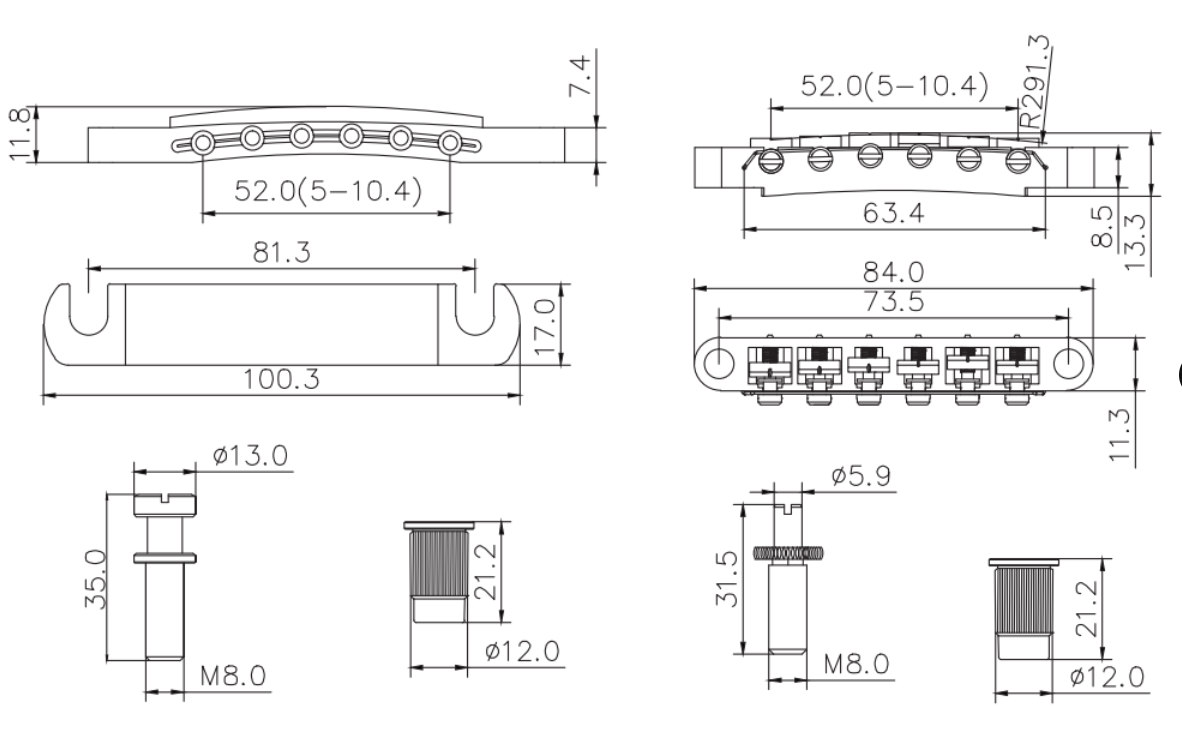
How to Identify and Measure Your Guitar Bridge Before Buying a Replacement?Updated a month ago
How to Identify and Measure Your Guitar Bridge Before Buying a Replacement?
Why Bridge Identification Matters?
Many guitar bridges look similar but use different mounting systems and dimensions.
Ordering a replacement based only on appearance can result in:
- Incorrect mounting hole spacing
- Incompatible studs or screws
- Poor string alignment
- Installation difficulties
Before purchasing a replacement bridge, identify your bridge type and verify its critical measurements.
Step 1: Identify Your Bridge Type
Tune-o-Matic (TOM)
Common on:
- Les Paul
- SG
- ES-335
Characteristics:
- Separate bridge and tailpiece
- Six adjustable saddles
- Mounted on two posts
Key measurements:
- Post spacing
- Post thread type
- Saddle/string spacing
Wraparound Bridge
Common on:
- Les Paul Junior
- Les Paul Special
- SG Junior
Characteristics:
- Bridge and tailpiece combined
- Strings wrap around the bridge
Types include:
Lightning Bolt Wraparound
Modern Compensated Wraparound
Adjustable Wraparound
Key measurements:
- Stud spacing
- Thread type
- String spacing
Stratocaster Tremolo Bridge
Common on:
- Stratocaster-style guitars
Characteristics:
- Tremolo arm
- Six saddles
- Spring cavity in rear
Key measurements:
- Mounting screw spacing
- String spacing
- Block dimensions
Telecaster Bridge
Common on:
- Telecaster-style guitars
Characteristics:
- Bridge plate mounted with screws
- Strings may pass through body
Key measurements:
- Mounting pattern
- Pickup cutout compatibility
- String spacing
Hardtail Bridge
Common on:
- Modern fixed-bridge guitars
Characteristics:
- No tremolo
- Fixed mounting screws
Key measurements:
- Mounting pattern
- String spacing
Floyd Rose Style Bridge
Common on:
- Metal and shred guitars
Characteristics:
- Locking nut
- Floating tremolo
- Fine tuners
Key measurements:
- Post spacing
- Stud diameter
- Tremolo cavity dimensions
Step 2: Determine Which Measurements Matter
Different bridge types require different measurements, but these are the most common.
Measurement
Why It Matters
Post spacing
Determines whether the bridge can mount
Screw spacing
Determines whether holes align
Thread size
Determines stud compatibility
String spacing
Affects string alignment
Baseplate dimensions
Determines fitment
Saddle travel
Affects intonation range
Step 3: How to Measure Bridge Correctly (Center-to-Center Measurement)
Most bridge dimensions are measured from the center of one mounting point to the center of another.
Correct: Measuring Center-To-Center
1O-------------O2^ ^3Center Center4
Not: Measuring outside edge to outside edge
1| O---------O |2
Not: Measuring inside edge to inside edge
1O |-------| O2
Measuring Stud Spacing
Used for:
- Tune-o-Matic
- Wraparound
- Floyd Rose
Measure:
Center of left stud → Center of right stud
Measuring Screw Spacing
Used for:
- Telecaster bridges
- Strat bridges
- Hardtail bridges
Measure:
Center of first screw → Center of last screw
Measuring String Spacing
Measure:
Center of low E string → Center of high E string
Typical guitar values:
- 50 mm
- 52 mm
- 54 mm
- 56 mm
Step 4: Common Bridge StandardsMetric Hardware
Common on:
- Most imported guitars
- Most DIY guitar kits
Typical threads:
- M4
- M6
- M8
Imperial Hardware
Common on:
- Gibson USA
- Fender USA
- Historic reissues
Typical threads:
- SAE sizes
- 6-32
- 8-32
- 10-32
Step 5: Buying a Replacement Bridge
When reviewing a product listing, verify:
✓ Bridge type matches
✓ Number of strings matches
✓ Post or screw spacing matches
✓ Thread size matches
✓ String spacing is compatible
✓ Mounting style matches
Common Mistakes
Buying Based Only on Appearance
Many bridges look identical but use different mounting dimensions.
Ignoring Thread Type
Correct spacing does not guarantee correct stud compatibility.
Mixing Metric and Imperial Hardware
A common source of fitment issues.
Assuming All "Les Paul" Bridges Fit All Les Pauls
Bridge specifications vary between manufacturers and production years.
If You Are Unsure
Before ordering:
- Identify the bridge type.
- Measure the critical dimensions.
- Compare them with the manufacturer's specifications.
- Contact the seller if dimensions are unavailable.
Providing photos of your guitar and bridge can also help verify compatibility before purchase.